Tuesday, March 26, 2013

Murky Work At The Iowa Capitol


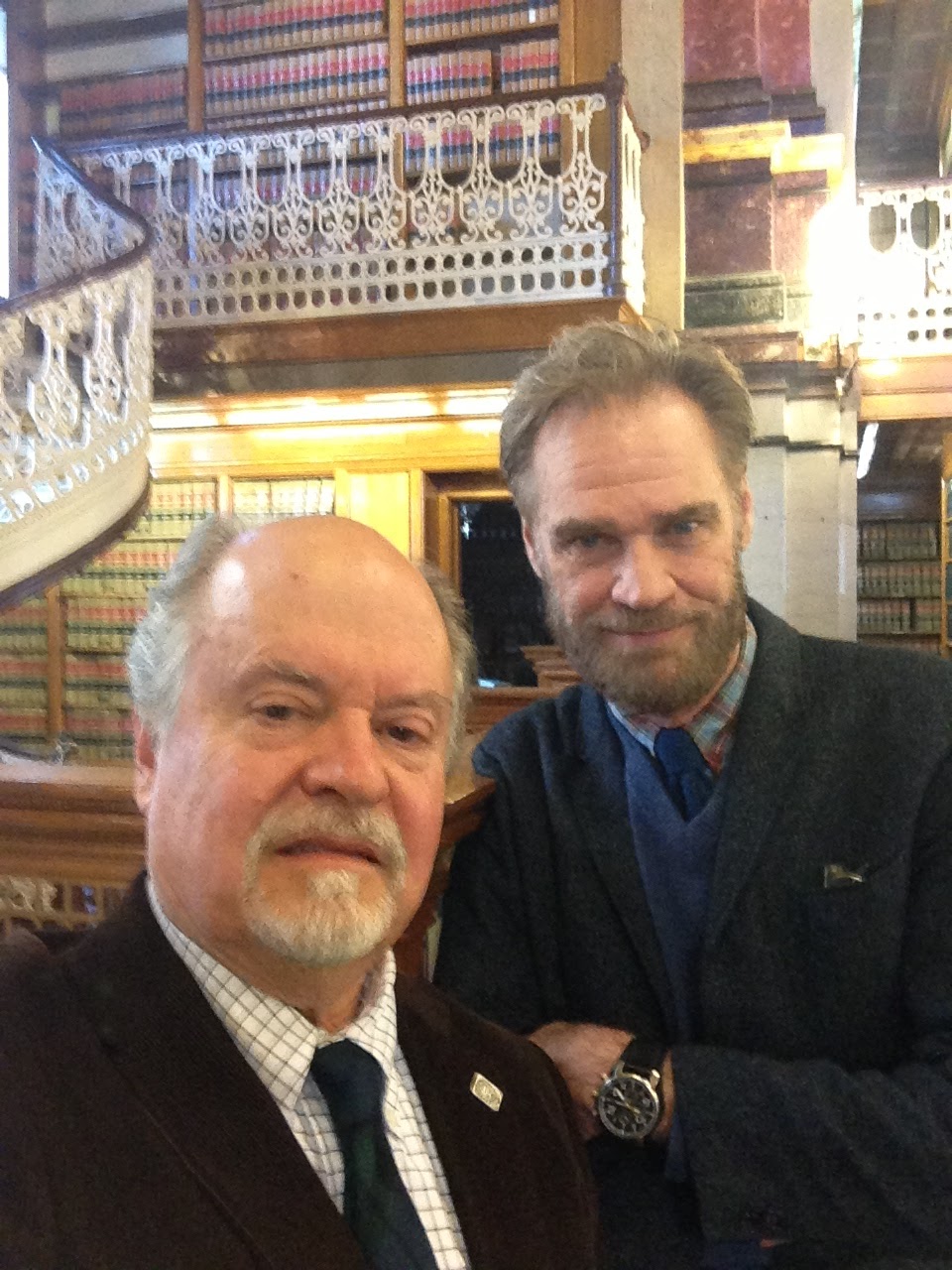
Four years of making the breathtaking (as in getting winded) walk up the steps to the Iowa State House.  The ups and downs, hope and despair, honesty and misdirection, a varied bouquet of experiences, all to stay on top of the revival of the Iowa Film Office!  And here we go again, Jay and I meeting with Iowa legislators to implement the idea that the squeaky wheel gets the grease.  We do squeak and it looks like the film office may get some grease at last.

It didn't take long for us to bump into our chief ally, Senator Bill Dotzler.  He said the senate appropriations study bill would be discussed as early as today and certainly by the end of the week.  I referred to the bill in my previous report, the one which included details in funding of the film office.  A reminder: the film office will be housed in Cultural Affairs and in a new Arts Division there.  After discussion in the senate, this bill will go to the house and then zig zag until everyone agrees on the language within the bill, such as the amount of money to be allocated for the film office.  Last year $200,000 was allocated, half of what Governor Branstad wanted, and now we know that half of that $200,000 has been spent.  One source told us that $100,000 was spent on "film-related business", although the film office isn't even reopened yet.  Another source said the money was more generally absorbed within state offices. (Hence the word "Murky" in the title of this report).

In addition, Jay and I also spoke with Rep. Dan Kelley and Anesa Kajtazovic, both of whom repeated their support for our mission.  A key player in all of this, Rep. Dave Deyoe, indicated that the Iowa House would likely go along with the Iowa Senate's recommendations after all is said and done.  It isn't clear if the remaining $100,000 in last year's film office budget would be supplemented to a lower House sum or added to the $400,000  suggested by the senate. 

We were told by Rep. Deyoe that he understood that the new Iowa Film Office director would be named next week.

Once the film office reopens, the new director will face a monumental task, to regain trust and interest from Hollywood producers.  Without tax credits in play the new director will have to use other incentives to make movies here worthwhile and attractive, such as our beautiful locations and talented and hardworking creative people.

Stay tuned.

Gene

photo: Jay and Gino

Tuesday, March 19, 2013

Merrily We Go Again On The Capitol MerryGoRound

I carried a folder with me today to the Iowa State House.  I had rubber-stamped "UNIMPORTANT" in large red letters on the front and back of the folder.  When Jay and I spoke with legislators I would first show them this folder to lightheartedly indicate our awareness of our status.  Every one of them found this to be very funny, which made our conversations very easy and pleasant.

Jay and I wanted to better understand the proposed Senate Appropriations Subcommittee On Economic Development Bill, which contains recommended funding provisions for the Iowa Film Office, so we took our copy of this proposed bill to the legislative services office and spoke with the person who actually publishes these documents and asked her what the heck all of this stuff says in easy to understand terms.  This person, Amber DeSmet, said the proposed bill provides $400,000 for the film office and suggests that unused IFO funds be carried over to next year's film office budget.  The film office is now in the cultural affairs department within the "arts division".  Cultural affairs is led by Mary Cownie.

We met with our friend Senator Bill Dotzler, who is one of the leaders in the Iowa Senate in the effort to fund and revive the film office and who is a primary author of the bill just mentioned.  On the House side, Rep. Dave Deyoe is the most important figure in this matter and he met with us today as well.  Rep. Deyoe suggested that the House will likely approve $300,000 to fund the IFO, versus the governor's recommended $400,000, but that he would not oppose the carry-over of unused IFO funds, which he believed to be over $100,000.  The original amount of the IFO funding from last year was $200,000, so it appears some of the money was spent on something unrelated to the operation of the film office.

The Senate Appropriations Subcommittee On Economic Development Bill is presently in the hands of the Iowa senate and will next be taken to the Iowa House to amend or strike and then be returned to the Iowa Senate to resist or approve and then back to the House to insist and then to a joint House and Senate discussion.  Did you follow that?  Did you fall off of the merry-go-round yet?  You've got to be dizzy.  Jay and I are!!!

Wednesday, March 13, 2013

Four More Years! (of waiting? I hope not!!)

Okay, okay, shall I begin as I always do, that Jay and I went yet again to the Iowa Capitol Building in our continuing effort to keep track of what is to become of the Iowa Film Office?  Sure, Jay and I went yet again to the Iowa Capitol Building today.  We got there early, before eight a.m. and met several legislators, which we always seem to do during these Iowa State House visits.

We had a quick conversation with  Senator Jack Hatch who has always voiced his support for we creative Iowans, and which he did again today.  Rep. Dave Deyoe spoke with us and told us he was fully behind the increase in the IFO budget.  Rep. Deyoe is one of the main players in this film office business on the House side.  Speaking of the House side, we enjoyed meeting with Rep. Dan Kelley of Newton, where films have been shot and many Iowans were employed by film-makers several years back.  Rep. Kelley has been a supporter from the beginning of his young legislative career.

Our strongest and most influential supporter is Senator Bill Dotzler from Waterloo.  Before convening a meeting in the former Iowa Supreme Court room, a meeting to discuss the Proposed Senate Appropriations Subcommittee on Economic Development Bill, a "bill for an act relating to appropriations to the department of cultural affairs" and more, the senator granted an interview with Iowa WHO Radio reporter Richard Lee.  I listened closely as Senator Dotzler spoke of the importance of movie making in this state, that movie making creates jobs and brings financial rewards to communities in which movies are made.  He spoke of how the film industry employs creative Iowans and brings Iowa into focus as an interesting place to visit as a tourist destination.  Following this radio interview Senator Dotzler opened the appropriations meeting.

Most of the meeting pertained to matters other than the film industry, such as funding the continued repair of Iowa Civil War battle flags, supporting the World Food Prize, Workforce Development, Job Training, and more.  Although Jay and I could not see any reference to the film office in the appropriations report, Senator Dotzler spoke at the meeting of how the governor's recommended sum of $400,000 should be implemented because of the cost of restarting the film office, including the expenses of buying computers and furniture and recreating a locations file and production guide.  He said funds presently in the IFO would be carried over to next year's film office budget.

Following the meeting, Senator Dotzler pointed out to Jay and myself the specific section in the planned bill that covers the film office budget.  This bill will now go to the senate floor and on to the house.  As I understand it, this  matter will be discussed next week.  Jay and I speak English.  We don't speak that legalese mumbo-jumbo, so when we review bills and investigate scheduled committee meeting agendas it's like trying to read a foreign language!

If you are a creative Iowan, someone who loves to act or who loves to work on the other side of the camera, or if you're someone who wants to see Iowa's cultural image improve, I suggest you email your Iowa legislators and tell them how important YOU think movie-making is for this state and for many Iowans.

(photo shows Senator Dotzler being interviewed by WHO Radio's Richard Lee.  Note Jay doing a "photo bomb" in the background).


Thursday, March 7, 2013

Iowa Film Office Closer To Reopening

Yet another excursion to the Iowa State House, home of the Big Golden Dome. We were immediately met by our ally, Senator Bill Dotzler, Jr., of Waterloo. Senator Dotzler is Senate Chairman of the Economic Development Budget Subcommittee and has served on other important committees and always stands for we members of the Iowa film industry and is readily available when Jay and I make our Iowa Capitol visits. On the other side in the Iowa House of Representatives, we were able to meet with the House Chairman of the above mentioned committee, Rep. Dave Deyoe, and vice chairman Rep. Bobby Kauffmann, who both indicated they were comfortably on board with increasing the Iowa film office budget from the current $200,000 to the governor's original suggested sum of $400,000. Rep. Deyoe said he wanted to be sure the film office has ample money to properly run and said Cultural Affairs Director Mary Cownie would be in charge of deciding how any funds would be used in her department. He also said Cownie is still interviewing candidates for the job of Iowa Film Office Director and that he expects a director to be named in a few weeks. Co-chairman Rep. Kaufmann said initial reaction to the $400,000 amount was that it is a good amount to get the IFO amply supported. We chatted briefly with other Iowa House Representatives, including Anesa Kajtazovic,Deborah Berry, and Peter Cownie. All of these legislators indicated that they approve of the increased IFO funding amount. The Director of Management and Budget, David Roederer, came by as we were perched at a table and spoke with us. He's in an important position in the governor's staff and is very much behind us and always has been. Last year the House was against the governor's recommended IFO funding sum of $400,000, and only half of that was allowed. The film office has not been active for going on four years and the $200,000 will be absorbed in the general Iowa funds unless the film office opens before July 1st. Stay tuned. (photo show Jay Villwock, Senator Dotzler, and myself.. we are in our determined pose).

Sunday, March 3, 2013

Just #^*&#%^ DO It! (Please)

If anyone out there is an actor or a crew person I hope they will simply email their representative AND senator and stress that the Iowa Film Office is vital for Iowa's CREATIVE ECONOMY because film-making means not only jobs for we creative actors and crew but income for whole towns and industries when movies are shot in their communities. It's easy to email legislators. Just go to Google and get the email addresses and off you go!! Letters to the D M Register wouldn't hurt, either. photo: Medium Me, Senator Dotzler, Tall Jay

Thursday, February 28, 2013

Our Fourth Year of Capitol Visits!!

Hard to believe, but today's visit to the Iowa Capitol Building marks the fourth year that Jay Villwock and I have gone there to meet with legislators and leading officials in the governor's office. We were able to speak with senators Joe Bolkcom, Bill Dotzler, Jack Hatch, and Brad Zaun. We also met with high-ranking staff members in the governor's office. Bottom line: 1. hundreds and hundreds of applications for the job of Iowa Film Office director have yet to be reviewed; 2. the film office is expected to re-open before July 1, the end of the current fiscal year; 3. it appears likely that the present IFO budget of $200,000 will be increased to $400,000 for the next fiscal year. This slow pace is intended to avoid making even the smallest mistakes, with extreme caution being exercised so another film office disaster will be averted. It was so great to team up with Jay again today. He is well respected at the capitol and is excellent in interacting with legislators and others. Stay tuned. Jay and I plan to make another trip soon. pictured: Gene, Rep. Dan Kelley, Jay Villwock

Thursday, October 11, 2012

Lee Thomas Article ..Dreaded Tax Credits

This article is taken from another person's blog: Moderated by Rick Badie A popular film industry tax credit has led some to call Georgia the Hollywood of the South. The director of the state film office calls the tax incentive a necessity in a competitive market. A tax analyst suggests it’s time for all states to roll up the red carpet and end subsidies for such a profitable industry. Tax incentives fuel filmmakers’ interest By Lee Thomas Last week, the Georgia Department of Economic Development released the state film office’s fiscal year 2012 economic impact numbers for the film industry — $3.1 billion. The state is currently hosting 32 film and television shows, from home improvement shows to scripted dramas and major feature films. In February 2007, we had one project filming here: the MTV reality show, “Yo Momma.” The economic impact for that fiscal year was $244 million. How did the state’s film and television industry grow over 1,100 percent in five years? First, by having a proactive legislature and governor who supported the Georgia Entertainment Industry Investment Act, a tax credit incentive of up to 30 percent for projects. Canada started offering incentives for entertainment projects in the late 1990s. Louisiana started the first competitive domestic incentives in 2002. We lost business to both of them. In 2005, when a biopic of Georgia’s native son, Ray Charles, was filmed in Louisiana, legislators decided enough was enough. Today, a market must offer incentives. Studios’ accounting departments dictate which states can be considered for projects. The tax incentive savings are typically rolled back into the budget, raising the spending level. The influx of cash into the economy is widespread. Georgia’s real estate market has been buoyed by shows that rent warehouses, offices, homes and apartments. The film business supports hotels, restaurants, rental car facilities and so on. More than 60 new businesses have expanded or located in Georgia since 2007, from major sound stages to production support companies. These companies are here because the level of business warrants it. They do not get the film tax credits. The film and television industry has provided tens of thousands of jobs to Georgians, not only in technical positions, but also as caterers, production assistants, painters, hair dressers, etc. A 2011 study indicated that for every dollar the state spends on tax credits, $1.24 is earned in state and local taxes. This does not take into account the value of having Jennifer Aniston talk about how she loves Clarkesville on “Good Morning America,” or the Georgia logo being on the credit roll of a film like “The Blind Side.” It does not represent tourists who travel to Georgia to see the Mystic Grill in Covington from “Vampire Diaries.” Senoia, which hosts AMC’s hit “The Walking Dead,” has seen businesses downtown increase from six in 2006 to 47 by 2012, largely due to the film industry. Georgia is uniquely situated for the film business. We have an experienced workforce and infrastructure to save the production companies money. We have a temperate climate so productions can film year-round. We have a diverse topography of mountains, beaches, plains, small towns and urban landscapes. We have great restaurants and the ease of access provided by the world’s busiest airport. Georgia does not have the highest incentive, but it is sustainable. All of these assets help make filming in Georgia cheaper, easier and more desirable than in most markets. The film industry in Georgia means business! Lee Thomas is director of the Georgia Film, Music and Digital Entertainment Office. Better uses for scarce dollars By Joseph Henchman This November, the Georgia State Archives reduces itself to three staffers due to budget cuts, making Georgia the only state without archives open to the public. Other state agencies have been asked to cut themselves 3 percent, the fifth consecutive year of budget and staff reductions. One program not seeing cuts is the state’s annual $200 million in film tax incentives. In recent years, more than $500 million in Georgians’ taxpayer dollars has been funneled to film and television production. Your tax dollars now pick up as much as 30 percent of qualified production costs of one of America’s most profitable and successful industries. Georgians see some benefits, it is true. The state has seen more productions. A couple thousand Georgians work in entertainment, producing everything from Tyler Perry’s hit movies to the poorly reviewed “Mean Girls 2.” But research by scholars on the left and right has found that most jobs “created” by movie productions are often temporary with limited upward mobility, the kinds of jobs that end when shooting wraps and the production company leaves. Film tax credits will never create an independent industry. Hollywood folks are clear that if the tax spigot is ever turned off, they’re gone. This isn’t a case of the state providing a bit of seed funding to a new industry. It’s subsidizing Hollywood productions for a few weeks’ work. Studio lobbyists are eager to ask for money, but promise no loyalty in return. When Georgia’s tax review commission looked at the credit last year, it recommended elimination. In response, those who benefit from the subsidies argued the credit doesn’t actually lose money since it is refunding tax that wouldn’t have been paid otherwise. I don’t buy that. Georgia had film productions even before the credit, but its credit is actually “transferable.” That means that if a Hollywood company gets a bigger tax refund than it owes, it can sell its unused tax credits to Georgians with big tax bills. That means the state is losing money it would have otherwise collected. Other states are realizing that there are better uses for scarce state tax dollars than expensive and ineffective film tax incentives. By our count, state subsidies for the film industry nationwide have dropped from their all-time record of $1.5 billion in 2010. Many states are at last evaluating the programs, especially after a major embezzlement scandal in Iowa sent film officials and producers to jail. Some states, like California and New York, are giving even more tax subsidies. California is now spending $100 million a year in film tax subsidies, and New York spends an astonishing $400 million a year. Topping them means essentially handing out money. Perhaps a better approach is rolling out the red carpet for everyone, not just the film industry. Instead of high taxes for everyone and low taxes for a few, why not even it out so everyone pays a little less? Small Georgia-grown film productions would benefit, as would loyal Georgia businesses that create jobs year after year. As for Hollywood films, Georgians could make some popcorn and enjoy movies that citizens in other states are subsidizing with their tax dollars. Joseph Henchman is vice president of legal and state projects for the Tax Foundation.